Cold Storage for Florists: A Complete Guide
Why Cold Storage Is the Heart of Every Floral Business
In the floral industry, your inventory is alive. Unlike canned goods on a grocery shelf or frozen products in a warehouse, cut flowers are living organisms that continue to metabolize, transpire moisture, and respond to their environment after harvest. The conditions in which you store your flowers directly determine how long they last, how vibrant they look, and ultimately how satisfied your customers are with their purchase. A quality floral cooler is not just a piece of equipment; it is the single most important investment in protecting your product, reducing waste, and maintaining the reputation that keeps customers coming back.
The floral industry faces unique cold storage challenges that differ fundamentally from food service or pharmaceutical applications. Flowers require a very narrow temperature range, typically 33 to 36 degrees Fahrenheit, combined with high relative humidity between 80 and 90 percent. They are sensitive to air velocity, ethylene gas exposure, and light conditions. And in many retail settings, the cooler must serve as both storage and product display, requiring design considerations that balance preservation with visual merchandising. This guide covers everything florists need to know about selecting, configuring, and operating a cold storage system that protects their floral investment.
Temperature: The Single Most Important Factor
Temperature control is the foundation of floral preservation. Every degree matters. Research from major floral industry associations has shown that the vase life of most cut flowers decreases by approximately one day for every two degrees above the optimal storage temperature. A cooler running at 40 degrees instead of 34 degrees might not seem dramatically different, but it can reduce the sellable life of roses from ten days to seven days, representing a 30 percent reduction in the time you have to sell the product before it begins to deteriorate visibly.
Achieving and maintaining the narrow 33 to 36 degree range requires a refrigeration system specifically designed for floral applications. Standard food service walk-in cooler systems are typically engineered to maintain temperatures between 35 and 38 degrees with acceptable fluctuations of plus or minus two to three degrees. For flowers, that fluctuation range is too wide. A system that cycles between 33 and 39 degrees might average 36 degrees, but the peaks at 39 degrees accelerate flower metabolism and reduce vase life. Floral coolers from International Coolers use precision digital controllers with narrow deadband settings that maintain temperatures within plus or minus one degree of the setpoint, providing the stable environment that flowers need to last.
Humidity: The Often-Overlooked Essential
While most florists understand the importance of temperature, humidity is frequently overlooked or poorly managed. Cut flowers transpire moisture continuously through their petals and leaves. If the surrounding air is dry, flowers lose moisture faster than they can absorb it from their water supply, leading to wilting, petal curling, browning of leaf edges, and a generally tired appearance that makes product difficult to sell. The ideal relative humidity for most cut flowers is between 80 and 90 percent, which is significantly higher than what standard commercial refrigeration systems typically maintain.
Standard refrigeration systems dehumidify the air as a byproduct of the cooling process. When warm, moist air passes over the cold evaporator coil, moisture condenses out of the air and drains away. This is desirable in food storage applications where excess humidity promotes mold and bacterial growth, but it is counterproductive in floral storage where humidity preservation is essential. Floral-specific coolers address this challenge by using oversized evaporator coils that operate at higher surface temperatures, removing less moisture from the air during each cooling cycle. Supplemental humidification systems can be added in climates or seasons where ambient humidity is particularly low, such as arid western states or northern climates during winter when heated indoor air is extremely dry.
Airflow: Gentle Circulation Is Key
Flowers need air circulation to maintain even temperatures throughout the cooler and to prevent stagnant air pockets where ethylene gas can accumulate and accelerate aging. However, the airflow must be gentle. Excessive air velocity across flower surfaces accelerates transpiration, drying out petals and foliage just as effectively as low humidity. The ideal floral cooler provides low-velocity air circulation that keeps the entire interior within one to two degrees of the setpoint without creating noticeable drafts across the stored product.
Achieving this balance requires thoughtful evaporator placement and fan speed management. The evaporator should be positioned so that cold air is discharged across the ceiling of the cooler and descends gently over the stored flowers rather than blowing directly onto product surfaces. Variable-speed fan motors allow the airflow rate to be tuned to the specific needs of the space, and some advanced controllers can modulate fan speed based on the current cooling demand, reducing airflow during periods when the compressor is not running and the coil is not actively cooling.
Display Coolers: Where Storage Meets Merchandising
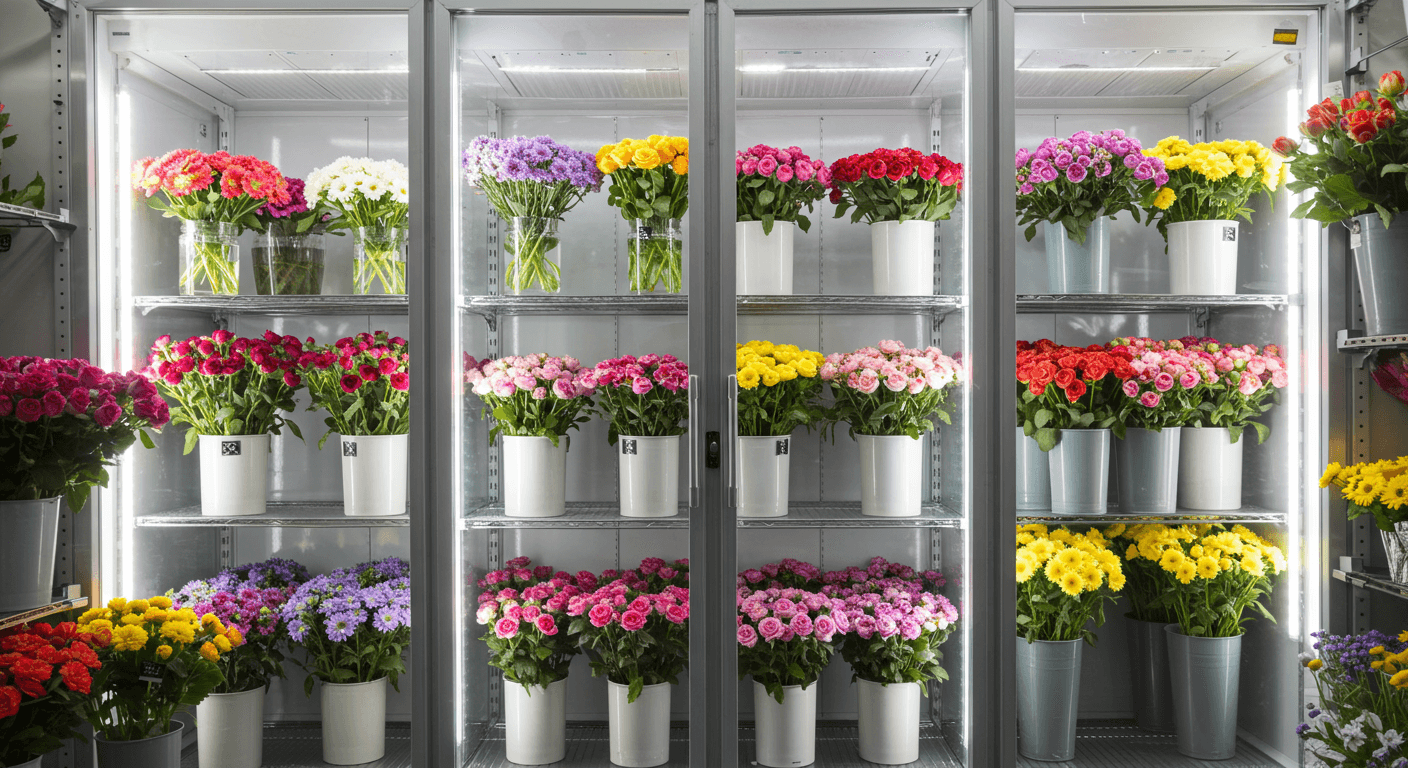
For retail florists and grocery store floral departments, the walk-in cooler is often the primary product display. Customers make purchasing decisions based on what they can see, and a well-designed display cooler showcases your flowers attractively while keeping them at optimal storage conditions. Glass door and glass wall configurations allow customers to browse the available selection from outside the cooler, and the visual impact of a well-stocked, beautifully lit floral display is a powerful sales driver.
Display cooler design requires careful attention to the thermal performance of the glass elements, which have significantly lower R-values than insulated panels. Double-pane insulated glass with low-emissivity coatings is essential to maintain acceptable energy performance, and anti-fog heating elements in the glass surface prevent condensation from obscuring the product display. Interior LED lighting should be chosen for color temperature and color rendering properties that enhance the natural beauty of the flowers. A color temperature around 3500 to 4000 Kelvin provides a balanced, natural light that makes reds, pinks, purples, and greens look vibrant and appealing. Avoid cool white lighting above 5000 Kelvin, which can make flowers look washed out and unnatural.
Sizing and Layout for Floral Operations
Floral cooler sizing follows different principles than food service sizing because of the way flowers are stored. Flowers are typically held in buckets or vases of water, which are taller and less space-efficient than the cases and containers used in food storage. Floral cooler shelving must accommodate these taller containers, and the shelving configuration should allow easy access to products at the back of the cooler without requiring staff to reach over or move other arrangements.
For a small retail florist processing 20 to 40 arrangements per week, a walk-in cooler in the six by six to six by eight foot range is typically sufficient, providing space for incoming stock, work-in-progress arrangements, and finished orders awaiting pickup or delivery. Medium-volume florists processing 50 to 100 arrangements per week generally need an eight by ten to eight by twelve foot unit. High-volume operations, event florists, and wholesale distributors may require significantly larger units, and International Coolers can design custom configurations to match any volume requirement.
Protecting Your Investment
Cut flowers represent a substantial perishable inventory investment, and the cost of lost product due to improper storage adds up quickly. A single warm weekend caused by a refrigeration malfunction can destroy thousands of dollars worth of inventory. Temperature monitoring systems with alarm notification provide essential protection, alerting you to problems before they cause irreversible damage. Battery-backed temperature loggers provide a record of storage conditions that can be valuable for insurance claims in the event of equipment failure. Regular maintenance of the refrigeration system, including coil cleaning, gasket inspection, and thermostat calibration, is the best preventive measure you can take to protect your inventory investment. Contact International Coolers to discuss the ideal floral cooler solution for your business.
Ready to get started on your project?
Whether you are planning a new walk-in cooler, replacing an aging freezer, or exploring insulated metal panel options, our team is ready to help.
Get a Free Quote