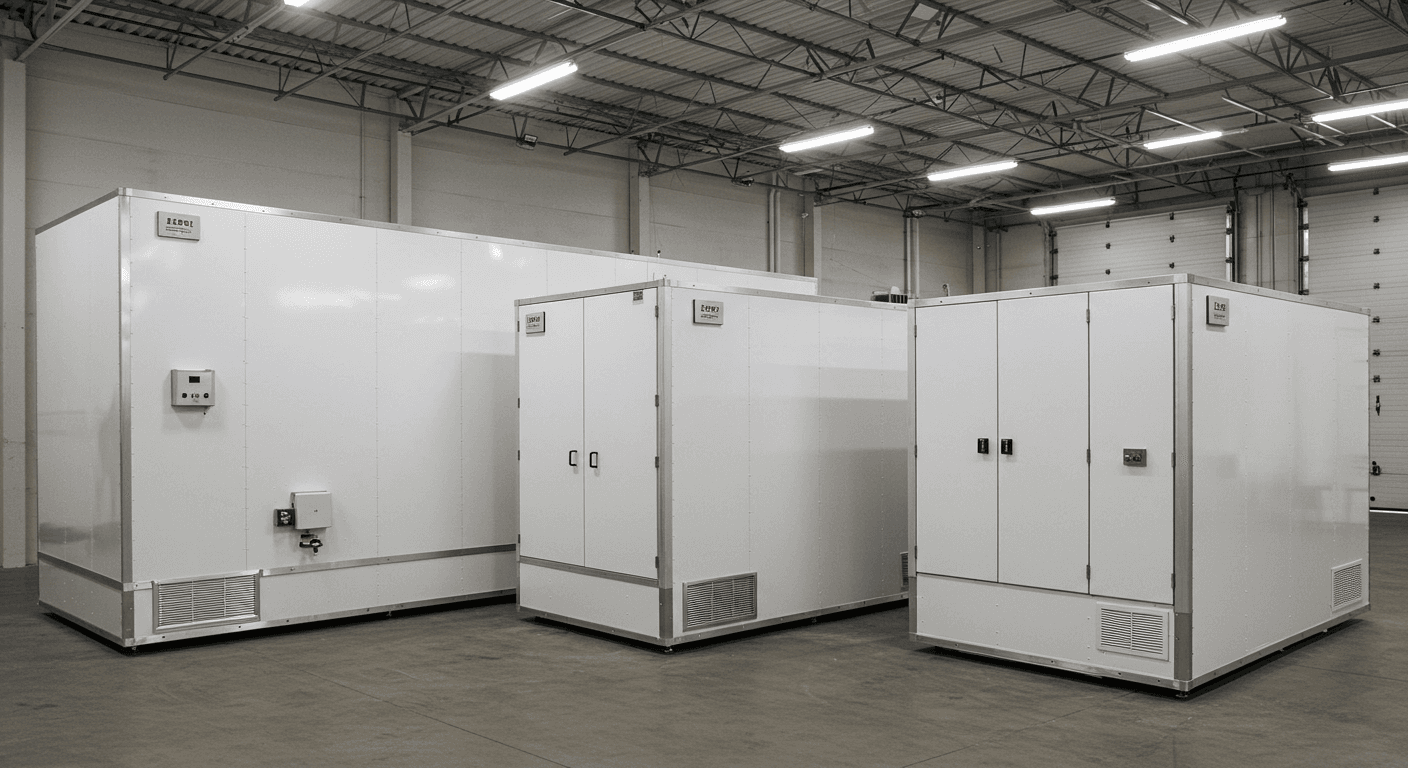
How to Choose the Right Walk-In Cooler Size
Getting the Size Right Matters More Than You Think
Choosing the correct size for a walk-in cooler is one of the most important decisions you will make when outfitting your food service operation, retail store, or production facility. A unit that is too small forces you to overstock shelves, restrict product variety, accept more frequent deliveries, and risk temperature problems caused by poor air circulation around densely packed products. A unit that is too large wastes valuable floor space in your building, costs more to purchase and install, and consumes more energy than necessary to maintain temperature in partially empty storage space. The goal is to find the size that accommodates your peak storage needs with enough room for proper air circulation and organized shelving, without paying for space you will never use.
Step One: Calculate Your Product Volume
The starting point for sizing a walk-in cooler is understanding how much product you need to store at any given time. This is not simply a matter of measuring your current reach-in refrigerators and adding up the cubic footage. You need to think about your maximum storage requirements, which typically occur around your busiest periods and immediately after your largest deliveries.
For a restaurant, start by listing every refrigerated product you use, from proteins and dairy to produce, beverages, sauces, and prepared items. Estimate the volume of each category at its peak, which is usually the day your main delivery arrives. For a convenience store, count the number of cases and units of each refrigerated product category you need to have on hand to maintain a fully stocked display plus backup inventory. For a food manufacturing or distribution operation, calculate the number of pallets or shelving units of product that need to be under refrigeration at peak capacity.
Convert these quantities into cubic feet. A standard case of restaurant food supplies occupies roughly 1.5 cubic feet. A full-size sheet pan takes up about two cubic feet of shelf space. A standard pallet loaded four feet high occupies approximately 48 cubic feet of floor space but about 200 cubic feet of volumetric space when stacked. These estimates give you a baseline product volume number to work with.
Step Two: Account for Shelving and Air Circulation
You cannot fill every cubic foot of a walk-in cooler with product. Shelving systems, aisle space for access, and air circulation gaps all consume space that is necessary for the cooler to function properly but is not available for product storage. A general rule of thumb used throughout the commercial refrigeration industry is that usable product storage capacity is approximately 50 to 60 percent of the total interior volume of the cooler. This means that if your product volume calculation from step one yields 200 cubic feet, you need a cooler with a total interior volume of approximately 330 to 400 cubic feet.
Air circulation is particularly important and often overlooked. The refrigeration system works by circulating cold air from the evaporator coil throughout the interior of the unit. If products are stacked directly against walls, packed tightly on shelves with no gaps, or placed directly in front of the evaporator discharge, air cannot flow properly. This leads to warm spots, inconsistent temperatures, and increased energy consumption as the refrigeration system works harder to compensate. Leave at least three to four inches of clearance between stored products and the cooler walls, and ensure that shelving allows air to circulate freely around all stored items.
Step Three: Consider Your Operational Workflow
Beyond raw storage volume, consider how you and your staff will use the cooler on a daily basis. A walk-in cooler that is sized perfectly for product volume but too narrow for comfortable staff movement will slow down your operation and create frustration. You need enough aisle width for staff to move through the cooler, turn around with cases in their hands, and access shelving on both sides without squeezing past each other.
For most food service operations, a minimum aisle width of 36 inches is recommended between facing shelving units. For operations where staff use hand carts or dollies to move product in and out of the cooler, 42 to 48 inches of aisle width is more practical. For distribution or manufacturing operations using pallet jacks or forklifts, aisle widths of eight feet or more are necessary, which fundamentally changes the size calculation and typically leads to drive-in rather than walk-in configurations.
Also consider the door location and how product flows into and out of the cooler. The door should be positioned to create an efficient traffic flow that does not require staff to walk past stored product to reach the items they access most frequently. First-in, first-out product rotation is easier to maintain when the cooler layout supports a logical flow from receiving to storage to retrieval.
Step Four: Match the Size to Your Available Space
The ideal cooler size based on storage calculations must be reconciled with the physical space available in your facility. Measure your available space carefully, accounting for clearances required around the cooler for air circulation, maintenance access, door swing, and code-required clearances from walls, ceilings, and other equipment. Most manufacturers recommend at least 12 inches of clearance on all sides of a walk-in cooler for airflow around the exterior panels, and self-contained refrigeration systems mounted on top of the unit require additional ceiling clearance.
If your available space is smaller than what your storage calculations suggest, you have several options. First, consider whether you can increase delivery frequency to reduce the peak storage volume you need to accommodate. Second, look at vertical storage solutions such as taller shelving units, keeping in mind that the cooler ceiling height must be sufficient and that staff need to be able to safely reach upper shelves. Third, consider a custom-sized walk-in cooler that is built to fit your exact available dimensions rather than settling for a standard size that wastes space or does not fit at all.
Common Sizes for Common Applications
While every operation is different, here are some general sizing guidelines based on common applications. A small restaurant or cafe serving 50 to 75 meals per day typically needs a walk-in cooler in the range of six by eight feet to eight by eight feet, providing approximately 300 to 400 cubic feet of interior volume. A medium-sized restaurant serving 100 to 200 meals per day often requires an eight by ten foot to ten by twelve foot unit, providing 500 to 750 cubic feet. A large restaurant, hotel kitchen, or institutional dining facility serving 300 or more meals per day may need a ten by fourteen foot to ten by twenty foot unit, providing 900 to 1,300 cubic feet or more.
Convenience stores typically require walk-in coolers in the range of eight by twelve feet to ten by sixteen feet for back-of-house storage, depending on the volume of refrigerated products carried. Floral shops generally need smaller units in the six by six to eight by ten foot range. Food manufacturing and distribution operations vary enormously in scale and are best sized through a detailed engineering analysis of production volumes and storage requirements.
When in Doubt, Size Up Slightly
If your calculations put you on the boundary between two sizes, it is almost always better to choose the larger option. The incremental cost of a slightly larger cooler is modest compared to the total project cost, and having a little extra space provides a buffer for business growth, seasonal peaks, and the inevitable tendency to store more products than originally planned. An undersized cooler creates daily operational headaches and may require expensive replacement or supplementation sooner than expected. Contact International Coolers for a personalized sizing consultation based on your specific products, volumes, and facility constraints.
Ready to get started on your project?
Whether you are planning a new walk-in cooler, replacing an aging freezer, or exploring insulated metal panel options, our team is ready to help.
Get a Free Quote